Jaikamal, it will not matter, as they are traveling perpendicular to the stream. Water speed will affect them differently in different directions only if traveling parallel to it. Here it will create the same drag whichever side they are moving so net effect is 0 (or rather can be neglected)
If both move at constant speeds, and in total they have covered 3 times as much distance by the second meeting, then each of them individually has covered 3 times as much. Make a small model of the swimming pool and convince yourself.:)
Sir, If you are considering 3 times of 120 since P travels thrice his distance then we get 360, however, it only traveled 90 when it returned for the second time and hence traveled 30 less (120-90). So shouldn’t the total distance be 360-30= 330. Can you please explain as to why you subtracted 90 from 360 instead of just the additional 30.
Sir, If you are considering 3 times of 120 since P travels thrice his distance then we get 360, however, it only traveled 90 when it returned for the second time and hence traveled 30 less (120-90). So shouldn’t the total distance be 360-30= 330. Can you please explain as to why you subtracted 90 from 360 instead of just the additional 30.
Sir I have a doubt in this. You said that if the speed is constant then the distance travelled individually by them would be in same multiplication of the total distance travelled by both of them ( i.e. 3) But dont you think it is valid when you start from the same point or in this case it can be applied after they met for the 1st time. its like to problem of fixed and variable part. You have to cover certain fixed amount and then after that it becomes linearly proportional.
I am not sure what exactly you are trying to say, but it certainly won’t be analogous to a fixed-variable situation. In TSD, unless otherwise stated, the speed of each individual in the problem remains constant.
Old CAT papers, SimCATs and other such tests…there’s loads of material out there. But don’t treat it like a board exam where you solve 50 questions of the same time. Instead look for different questions, variety, and understand each.
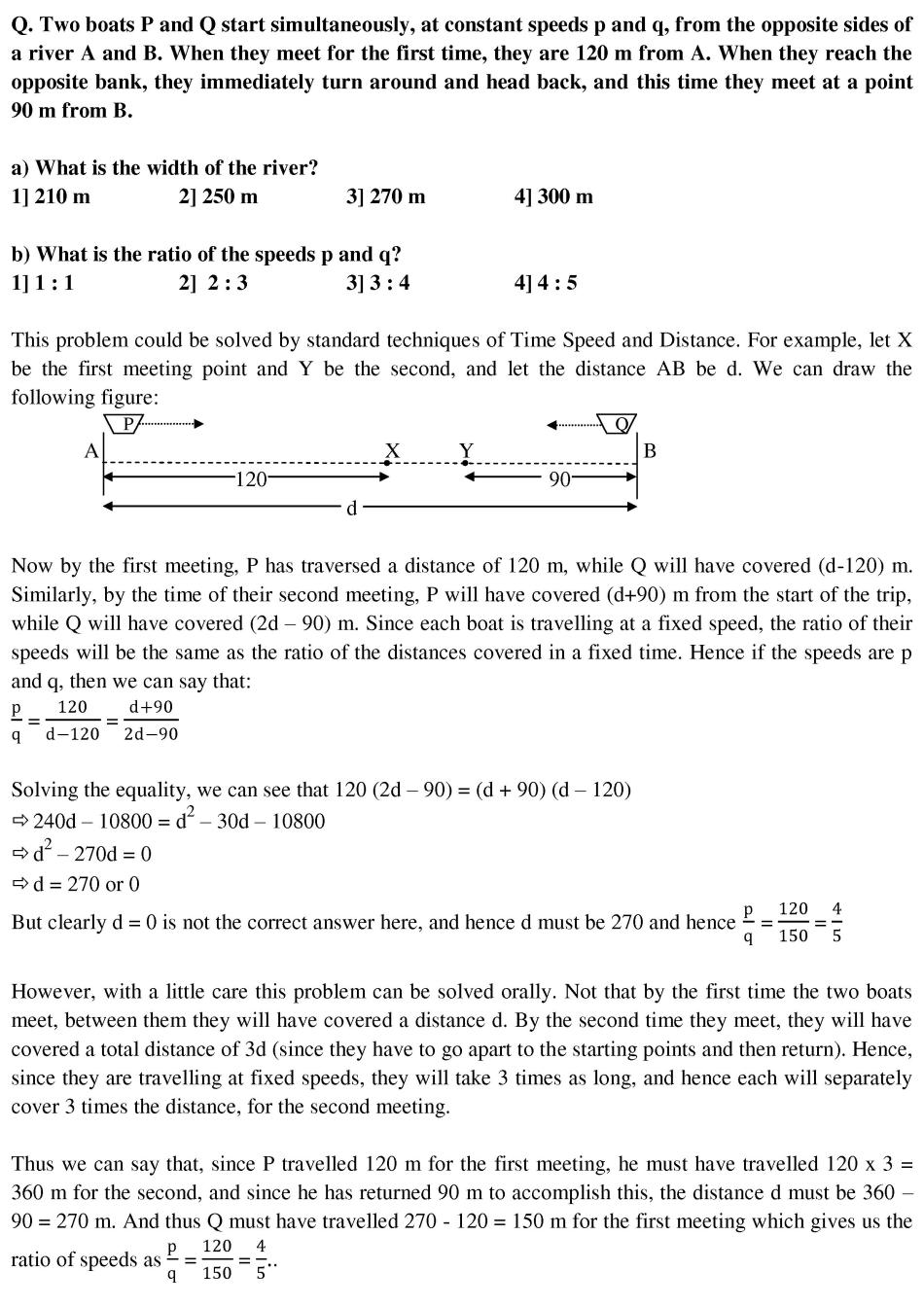
In this question, the information regarding still water is missing.
By jaikamal on July 23, 2013 at 12:45 AM
Jaikamal, it will not matter, as they are traveling perpendicular to the stream. Water speed will affect them differently in different directions only if traveling parallel to it. Here it will create the same drag whichever side they are moving so net effect is 0 (or rather can be neglected)
regards
J
By catcracker on July 23, 2013 at 12:54 AM
sir, how have you concluded that P travels 3 times the distance for the second meeting??
By Anuj Goyal on December 19, 2013 at 11:08 AM
sir,P travels 3 times the distance for the second meeting?
By Jayavignesh on September 29, 2014 at 12:26 AM
Could you elaborate
By Jayavignesh on September 29, 2014 at 12:27 AM
If both move at constant speeds, and in total they have covered 3 times as much distance by the second meeting, then each of them individually has covered 3 times as much. Make a small model of the swimming pool and convince yourself.:)
regards
J
By catcracker on September 29, 2014 at 1:08 AM
how it covered P covered d+90 in second trip
By vivek on October 19, 2014 at 3:18 PM
Sir, If you are considering 3 times of 120 since P travels thrice his distance then we get 360, however, it only traveled 90 when it returned for the second time and hence traveled 30 less (120-90). So shouldn’t the total distance be 360-30= 330. Can you please explain as to why you subtracted 90 from 360 instead of just the additional 30.
By Amruta on September 10, 2016 at 1:14 AM
Sir, If you are considering 3 times of 120 since P travels thrice his distance then we get 360, however, it only traveled 90 when it returned for the second time and hence traveled 30 less (120-90). So shouldn’t the total distance be 360-30= 330. Can you please explain as to why you subtracted 90 from 360 instead of just the additional 30.
By Amruta on September 10, 2016 at 1:17 AM
If you go from home to college, and then drive 1 km back, and find that your total distance driven is 10 km, how far away is your school?
regards
J
By catcracker on September 10, 2016 at 1:40 PM
School would 5 km away. Is it correct Sir ?
By nitishchandran09 on September 12, 2016 at 4:47 AM
No. Please read carefully, and think.
By catcracker on September 12, 2016 at 11:31 AM
9 km away!
By Sach on September 26, 2016 at 11:48 PM
Sir I have a doubt in this. You said that if the speed is constant then the distance travelled individually by them would be in same multiplication of the total distance travelled by both of them ( i.e. 3) But dont you think it is valid when you start from the same point or in this case it can be applied after they met for the 1st time. its like to problem of fixed and variable part. You have to cover certain fixed amount and then after that it becomes linearly proportional.
By Simarjeet Singh on December 26, 2016 at 12:23 AM
I am not sure what exactly you are trying to say, but it certainly won’t be analogous to a fixed-variable situation. In TSD, unless otherwise stated, the speed of each individual in the problem remains constant.
regards
J
By catcracker on December 31, 2016 at 12:40 PM
Thanks J.
You are the King.
By Blogger Went Full Retard on August 4, 2017 at 9:04 PM
brilliant articles sir!all of them!
By Rahul Kashyap on October 27, 2018 at 3:34 AM
complex problem, beautifully solved.
By Rishabh on July 30, 2020 at 8:36 AM
Sir where can i find more of this type questions for practise?
By Manik on September 21, 2020 at 8:53 AM
Old CAT papers, SimCATs and other such tests…there’s loads of material out there. But don’t treat it like a board exam where you solve 50 questions of the same time. Instead look for different questions, variety, and understand each.
regards
J
By catcracker on September 21, 2020 at 10:10 AM
Sir, a correction is required in first question. In question time is given in minutes whereas in solution it is taken in seconds.
By Nishant Gaurav on April 29, 2021 at 9:51 PM
Not sure what you mean, time is not involved at all, only distance.
regards
J
By catcracker on October 11, 2023 at 10:08 AM